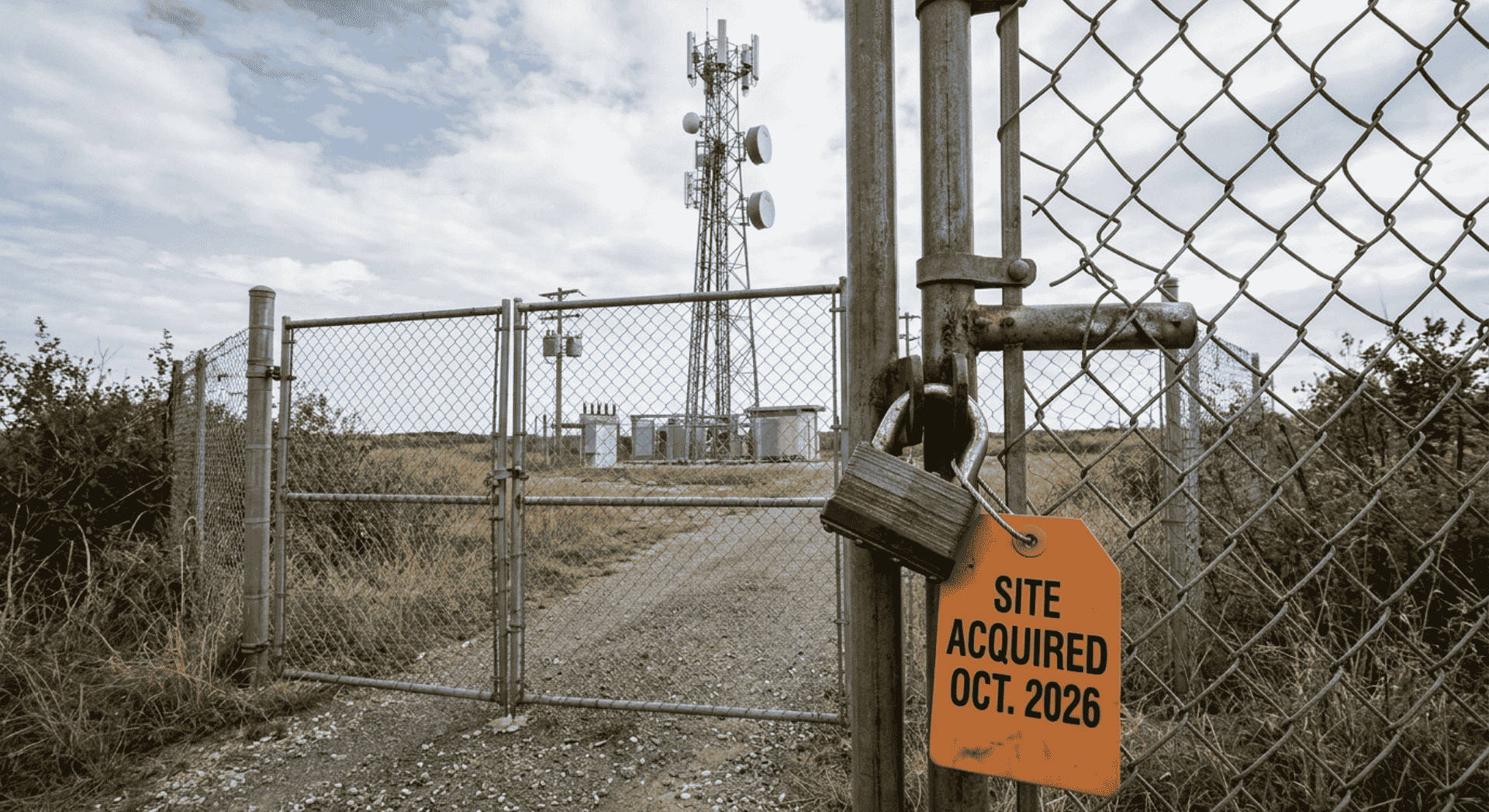
If a tower company has called or written lately asking to buy your cell tower lease, you are not imagining things. On October 21, Crown Castle reported that it spent $40 million buying land under its towers in the third quarter of 2026, two and a half times the $16 million it spent in the same quarter last year.
Crown Castle is not alone. American Tower and SBA Communications are also spending heavily to own the ground beneath their steel rather than rent it from you. Here is what is happening, why it is happening, and what it means if you are a landowner with a tower on your property.
Crown Castle hit the accelerator
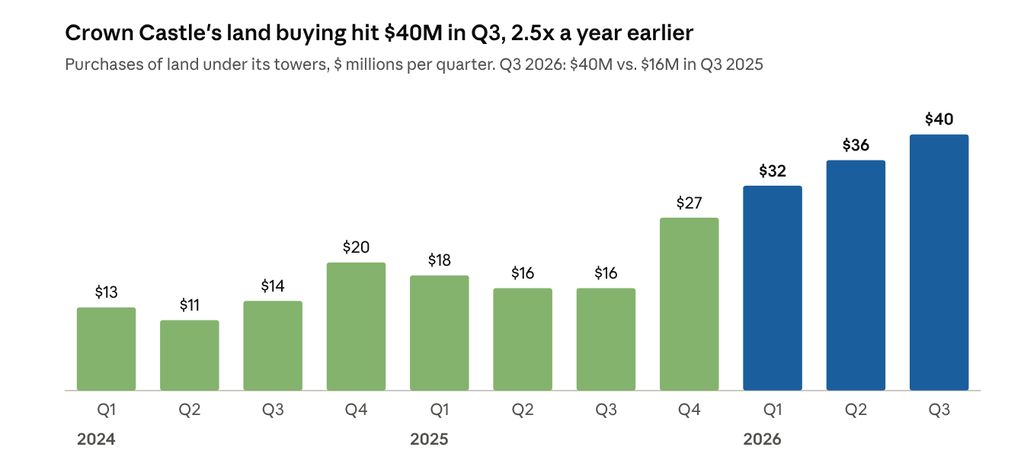
Through the first nine months of 2026, Crown Castle spent $108 million buying land, more than double the $50 million it spent over the same months of 2025, and already well past its $77 million total for all of last year. It also raised its 2026 spending plan by $40 million, citing more ground lease buyouts. On its October 21 earnings call, Crown Castle said it expects to buy more than 400 ground leases in 2026, more than double the number it bought in 2025. Management has said it wants to own the land under as much as 40% of its towers, up from about 30% today.
All three big tower companies are buying
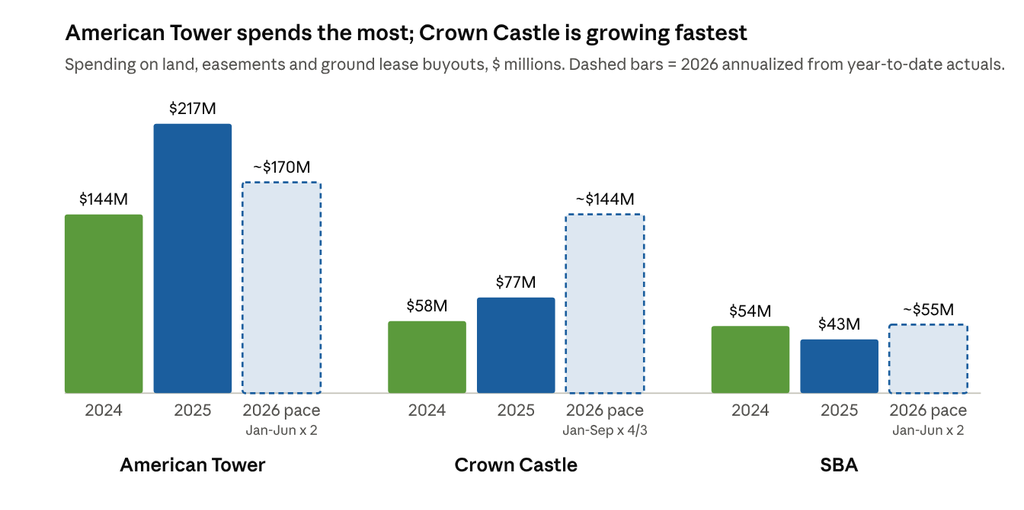
2026 figures are straight-line run rates from year-to-date actuals: American Tower and SBA = Jan-Jun x 2; Crown Castle = Jan-Sep x 4/3. Actual spending may differ, since buyouts are often heavier in Q4. Sources: American Tower 10-Ks and Q2 2026 10-Q; Crown Castle supplements and Q3 2026 release; SBA quarterly releases. American Tower and SBA include international sites.
American Tower is still the biggest buyer by far. Its 2025 spending was more than Crown Castle and SBA combined. Its first-half pace is a bit slower, but it still expects to spend $200 million to $220 million in 2026. SBA’s regular program is smaller, but don’t read the dip as disinterest: in January it paid $109 million for the land rights under roughly 3,900 sites in Guatemala, reported separately from the figures above.
Why tower companies want your land
- Your rent is one of their largest costs, and it never stops growing. Every check they send you has an escalator built in. Buy the land once and that bill is gone for good. Crown Castle told investors this quarter that its extra buyout activity is already trimming its operating costs.
- Owning the ground ends the negotiation. A tower company that owns the land never faces an expiring lease, a landowner who says no, or a request for a share of new carrier revenue. Investors pay for that certainty.
- Buying first keeps the aggregators out. Every lease a tower company buys is one a third-party lease buyout company can’t. When an outside investor owns the ground, the tower company has to deal with a sophisticated landlord who knows exactly what the site is worth.
- Offers are priced on today’s rent, so underpriced leases are bargains. A buyout multiple is applied to what you’re paid now, not what your site would command in a fair negotiation. If your rent is below market, the tower company is buying that discount along with the land.
- For Crown Castle, land is where the money can go. Crown Castle sold its fiber and small cell business this spring for about $8.5 billion. In our view, its stock price makes it hard to compete for new tower portfolios against buyers with cheaper capital. That leaves cash to put to work and few places to put it, and the ground under its own towers is the obvious target.
Here is why the deal works so well for them:
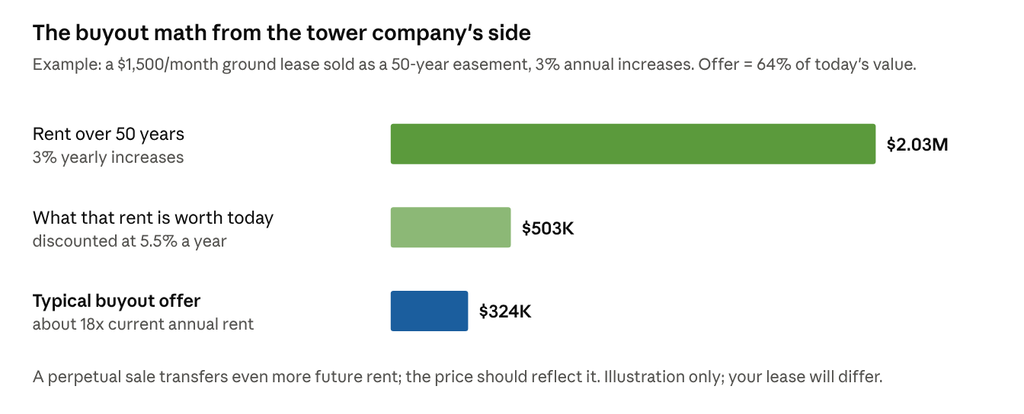
A lump sum today is worth more than the same dollars spread over 50 years, so the fair comparison is the middle bar, not the top one. Even so, a typical offer comes in at only about two-thirds of what that rent is worth today. The gap comes from who sets the discount rate in a buyout offer: the buyer. A rate a few points higher than yours can move the price by six figures.
What this means for you
More money flowing into land programs means more letters, more calls, and more “limited time” offers. That is not a reason to sell. It is a reason to know your leverage before you answer.
A bigger budget is not a bigger price. Nothing in the filings says they are paying more per lease. A larger budget can simply mean more leases bought at the same prices. Their offer is priced to make sense for them. Your job is to find out what it should be for you.
Crown Castle’s numbers back that up. Our rough math: in 2025 it spent $77 million on fewer than 200 leases, more than about $385,000 each on average. At its 2026 pace (about $144 million for more than 400 leases), the average works out to under about $360,000. That points to more deals at similar or slightly lower prices, not richer offers. These are rough figures: the spending line can include land purchases other than lease buyouts, and Crown Castle gave the lease counts only as “more than.”
Never use these averages to price your own lease. An average across hundreds of sites mixes high-rent urban towers with low-rent rural ones, long remaining terms with short ones, and strong leases with weak ones. It tells you nothing about what your lease is worth or whether you should sell. Comparing your site to Crown Castle’s average is apples to oranges.
The tower company is usually your best buyer, and it knows that. As we explain in our lease buyout FAQ, tower companies typically pay the most for their own leases because owning the ground is worth more to them than to anyone else. Many leases also give them a right of first refusal, so they can match any outside offer you bring in.
An extension request is the same strategy in different clothes. If they cannot buy your land, the next best thing is locking up decades of additional term for a modest signing bonus and a small rent bump. Before you sign any extension or renewal, know what your site is worth to them and how hard it would be to replace.
If an offer is on your kitchen table right now:
- Know what you’re selling. A perpetual sale can be the right choice, but it also hands over the rent beyond your lease’s current term. Make sure the price reflects that.
- Get more than one offer, on the same terms, so you can actually compare them.
- Run your own numbers. Our buyout calculator shows the discount rate a buyer is really using.
- Read the purchase agreement before the letter of intent, not after.
What the numbers don’t tell us
We want to be straightforward about the limits here. Apart from Crown Castle’s lease count, the companies report dollars, not deals, and none of them says what individual landowners were paid. American Tower and SBA also include international sites, and SBA’s figure includes money spent extending existing ground leases, not just buying them. Crown Castle’s towers are all in the U.S., so its numbers are the cleanest read on the domestic market.
Bottom line
The three largest tower companies are telling Wall Street, in plain terms, that buying the land under their towers is one of the best uses of their money. When a buyer is that motivated, the seller should not be in a hurry. Whether you are looking at a buyout offer, an extension request, or a renegotiation, find out what your lease is worth before you respond.
Steel in the Air has advised landowners on cell tower leases since 2004, and we only work for landowners. If you have received an offer, contact us. The initial discussion is free.
Sources: Crown Castle Q3 2026 earnings release · American Tower 2025 Form 10-K · American Tower 2024 Form 10-K · SBA Q4 2025 results · SBA Q1 2026 results · SBA Q2 2026 results