
Our Advisory Team
New Cell Tower Lease Rates & Negotiation Guide (2026 Edition)
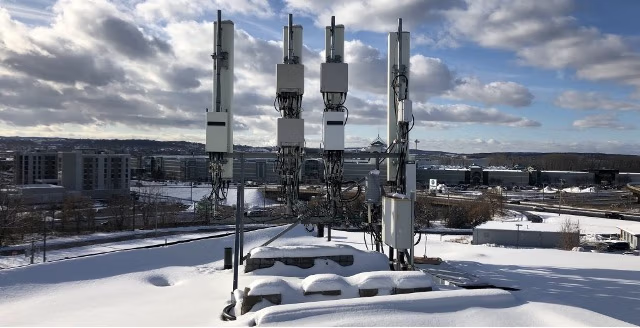
2026 Industry Snapshot
As 5G densification matures, the wireless landscape has shifted from “coverage at any cost” to “capacity and efficiency.” With the T-Mobile/US Cellular merger finalized, DISH’s planned exit, and carriers increasingly ceding new tower development to private tower companies, landowners now face an environment in which developers are far more aggressive and “thrifty” in negotiations than carriers have historically been.
Contact Us
How Much is a Cell Tower Lease Worth in 2026?
The average ground lease in our database is $1,300 per month. However, there is substantial variation in cell tower lease rates. How do we know? We have tracked them over the last 25 years in our proprietary cell tower lease database.
As noted earlier in this article on the impact of inflation on cell tower leases, cell tower leases have not kept pace with inflation. Thus, you can’t simply look at previous leases and apply an inflation rate to come up with today’s rate. If anything, new lease proposals in 2026 are lower on a straight-dollar basis. Coupled with lower escalation and more unfavorable terms, the 2026 cell tower lease is worse than those in previous years.
However, the value of unique properties remains high. Determining whether your property is unique is important. That’s what we at SITA do: determine whether you have leverage in negotiations with the wireless carrier or tower company for a new cell tower lease.
2026 Lease Rate Benchmarks
Market Reality
Most new lease proposals in 2026 range from $500 to $1,250 per month. In urban areas, offers generally start at $1,000 per month and go up from there, with some areas like
New York City and San Francisco are noticeably higher. While these figures reflect the current market standard, the long-term value of your lease lies in the terms—specifically, the
escalators and expansion rights—rather than the initial rent alone.
| Location Type | Monthly Rent Range | Key Value Driver |
|---|---|---|
| Urban / High Density | $1,200 – $2,500+ | Zoning limitations and availability of other towers |
| Suburban / Commercial | $800 – $1,500 | Zoning restrictions and suitable alternatives |
| Rural / Highway | $500 – $1,000 | Elevation, fiber proximity, and lack of nearby structures |
| Rooftop (Macro) | $1,500 – $3,500 | Lack of similar height buildings in the surrounding area |
The Danger of "AI-Generated" Counterproposals
A growing and dangerous trend in 2026 is landowners using AI to generate counteroffers. While AI might seem convenient, it lacks the nuanced market data and human judgment required for this specialized field.
The “Hallucination” Risk
AI chatbots often suggest “fair market rates” that are more than double the actual rate for a specific area. They also recommend lease terms such as revenue share and termination rights for the landowner, which are beneficial. But in many cases, requesting these will push the interested carrier or tower company to a neighboring property.
Data Privacy Concerns
Many landowners are rightfully hesitant to “feed” their confidential lease details into an AI. Sharing your private property data with an algorithm is a permanent choice with no guarantee of privacy. It may also be a breach of your lease agreement. If you provide us with information or a copy of a lease, we will treat it confidentially.
Lead Sorting vs. Human Advocacy
Some competitors in this industry use AI to “sort” incoming leads, ignoring clients who don’t have massive “upside.” At Steel in the Air, we believe every landowner deserves humane, individualized attention—regardless of site
size.

Major 2026 Market Shifts You Must Know
The Rise of the Aggressive Private Tower Company
A major shift over the last few years is carriers (Verizon, AT&T, T-Mobile) ceding more new tower development than ever to private tower companies.
- The Negotiation Gap: Historically, carriers were more focused on speed-to-market;
today’s private tower companies are focused on their own margins. They are significantly more aggressive, often using high-pressure tactics and “thrifty” offers that do not reflect the site’s true utility. - Prepaid Offers: Tower companies are making more “lump sum” prepaid cell tower lease offers than ever. In almost all cases, these are financially inferior to a monthly rent structure when calculated on a present-value basis.
The Impact of Carrier Consolidation on New Leases
The T-Mobile and UScellular merger has created “redundancy.” Rather than build new towers/cell sites, T-Mobile will assume ownership of up to 2,500 UScellular cell sites.
Additionally, DISH’s likely exit from the market means one fewer potential rooftop or collocation tenant, reducing the upside for tower developers and building owners alike.
Four Pillars of a "Future-Proof" Lease
The “missing link” for most landowners is knowing when to push back and when to stop. This is where professional site utility analysis—not AI—is required to assess if the carrier has a viable “Plan B.”
The Escalator Battle
While 3% was once the standard, many developers now push for 2% or less. Even a 0.5% difference can represent six figures in lost value over 25 years.
Right of First Refusal (ROFR): Strike this clause
It scares away legitimate buyers and reduces your asset’s marketability. Ideally, it should be removed from any lease. However, most tower companies will require it, in which case it should be limited.
Equipment Modification Limits
Modern 5G/6G hardware is heavy. Limit "weight and wind load" expansion and require a structural analysis for any significant modifications.
Sublease Revenue Share
While rare in today's market, there are occasions where the landowner is in a position to require it. However, you should never permit subleasing under a rooftop or tower colocation lease. EVER.
Professional Assessment & Consulting Scope
Don’t leave hundreds of thousands of dollars on the table. Steel in the Air provides a comprehensive business and financial assessment that AI cannot replicate.
Our Professional Scope Includes:
- Business Term Review: A thorough review of all non-legal business terms and conditions in the Proposed Lease.
- Zoning Analysis: Analysis of local zoning regulations to determine restrictions on new or alternative sites as alternatives for the Wireless Service Provider.
- Alternative Property Identification: Identify and review other existing Alternative Properties and evaluate them against the Client’s site to determine true leverage.
- Co-Location Evaluation: Identify and review potential for additional Co-Location at the Client’s site.
- Proprietary Comparable Data: Provide comparable lease data points for similar existing leases in the Client’s area.
- Negotiation Strategy & Tactics: Review of proposed offer and analysis of the parties making such offers, including hidden traps or terms the Client may not have considered.
- Agreement Optimization: Suggestions on how to improve the agreement to maximize the Client’s interests.
- 12 Months of Ongoing Guidance: Providing follow-up questions and answers as required for a period of 12 months after delivery of the written Assessment.
- Note on Legal Review: Our review is a business/financial assessment and is not a legal review of the lease. It is not intended to replace a legal review. You should have any legal document reviewed by an attorney.