
Cell Tower Lease Revenue Sharing
If a tower company offers a cell tower lease revenue share, it generally sounds like a bonus. In practice, it is usually a distraction — used by tower companies, carriers, and lease buyout companies to shift the conversation away from what your lease is actually worth. This page explains the key questions every landowner should ask before agreeing to — or walking away from — any revenue-share proposal.
What Is Revenue Share and How Does It Work?
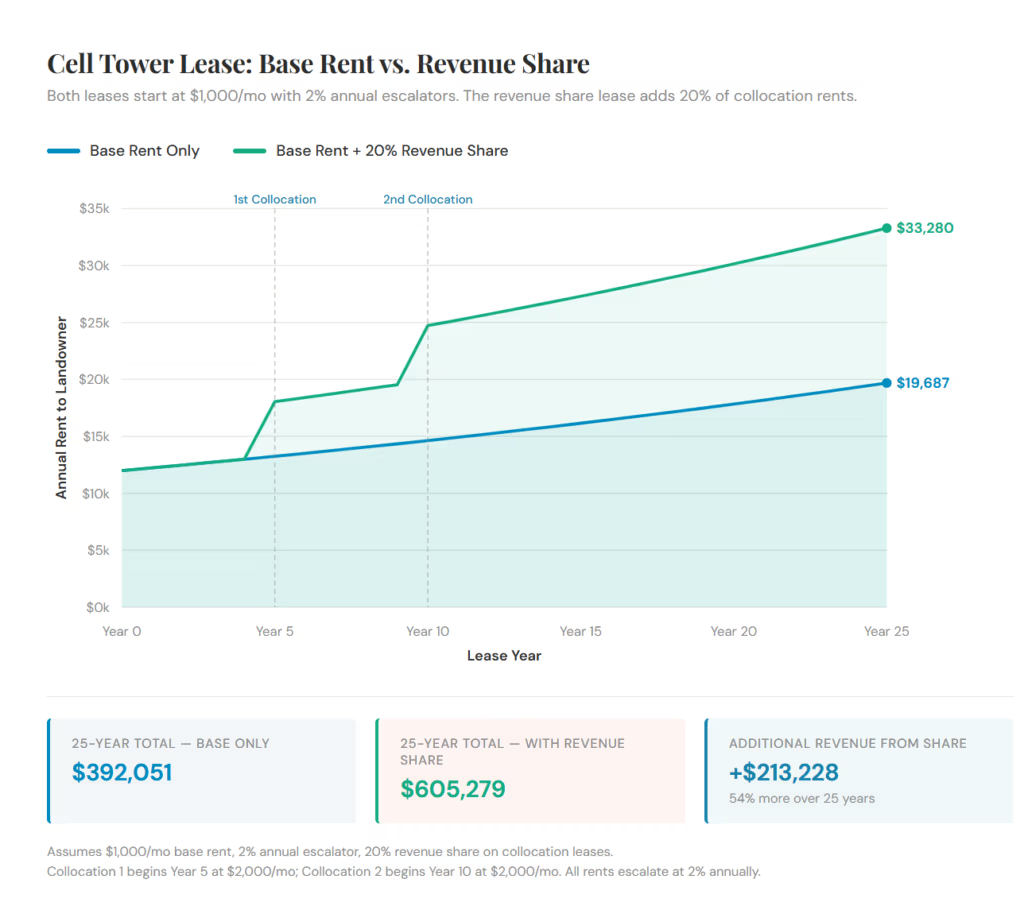
A revenue share provision gives the landowner a cut of the money the tower company or carrier receives when it subleases space on your tower or rooftop to additional wireless tenants. Generally, the first wireless carrier on the tower does not pay revenue share or have it applied to their rent payments; the revenue share applies to the second collocator on the tower and those after it. Below is a graph that shows the benefit of a revenue share.
Three Common Structures — Not Equally Favorable
Percentage of Gross Sublease Revenue
ties your payment directly to what the tower company collects for subtenants AFTER the first subtenant. If that amount goes up, so does yours — but if the tower company renegotiates its tenant agreements downward, your payment drops too, sometimes retroactively. This is still the preferred revenue share method for most landowners- and the hardest to get.
Flat rate per tenant
gives you a fixed dollar amount per additional carrier, regardless of what they are actually paying. It caps your upside and typically does not escalate. Tower companies prefer it because it limits their exposure and makes it easier to calculate monthly lease payments to landowners.
Percentage of all gross or net income
means the tower owner pays a % of the cumulative rent or net income they receive from all their tenants. Gross rent is much easier to verify than net income. However, tower companies generally do not offer this type of revenue share unless you have a unique property or a unique tower site.
Should I ask for A Revenue Share?
| New lease proposals | Lease extensions & expirations | Lease buyout offers |
|---|---|---|
| Why it comes up | Why it comes up | Why it comes up |
| Landowners ask for it — often prompted by generic advice from AI tools or attorneys unfamiliar with the wireless industry. | Tower companies offer it, usually as a sweetener in renewal negotiations — framing it as a bonus when it rarely is. | Buyout companies add it when the lump sum alone cannot justify the sale — promising future tenants to close the gap. |
| The real dynamic | The real dynamic | The real dynamic |
| Fewer than 10% of leases include any revenue share today, and that number is declining. Carriers and tower companies dislike the disclosure obligations and will often find another site rather than agree to it. | Tower companies do not give away future income on sites they expect to grow. An offer of revenue share usually signals they do not expect additional tenants — or that a sublease is already being negotiated before the amendment is signed, locking the landowner out. | The buyout company does not control the tower. The tower company does the marketing. Buyout companies often seek expanded easements — a land grab — hoping to capture space for future tenants. If it works, the landowner receives 50% of income from their own property instead of 100%. |
| The core risk | The core risk | The core risk |
| If your property is not genuinely unique, asking for revenue share does not get you revenue share. It gets the tower built on your neighbor's property. | Any additional amount from a revenue share is almost always worth less than the base rent increase you could have negotiated instead — and signing too quickly may forfeit any share of tenants already in the pipeline. | Any premium the buyout company pays for the expanded easement or rooftop rights is almost always worth far less than the present value of the future income they are acquiring. |
| SITA's take | SITA's take | SITA's take |
| Ask us first. We assess whether your property is irreplaceable. If it is, we help you pursue revenue share on the right terms. If it is not, we focus on what actually moves the needle. | We can forecast the probability. By examining carrier coverage, network gaps, and deployment trends at your specific site, we can tell you whether that revenue share offer represents real upside or a distraction from a better base rent negotiation. | Treat it as zero. We model the economics with the revenue share valued at nothing. If the lump sum alone does not justify the sale, the deal does not work — regardless of what the projections say. |
Questions Every Landowner Should Ask
Why are they offering a revenue share?
When a tower company offers to add revenue share as part of a lease renewal, most landowners assume it is a concession. It usually isn’t. Tower companies do not give away a share of future sublease income on sites where they expect that income to grow. If they are offering it, they either do not expect additional tenants or are using it to offset a lower base rent increase than you deserve. Or they condition the revenue share on tenants that commence their sublease AFTER your lease amendment is signed with the tower company. In the past, we have observed tower companies negotiating subtenant leases, signing them between the date the landowner agrees to the new amendment and before the tower company signs it, thereby preventing the landowner from receiving any revenue share.
The right question at lease renewal is not how much the revenue share might pay. The question you should be asking is why the tower company is offering it, and what they know about this tower’s future that you do not.
Want to know the real probability you will ever see a dollar from that revenue share? We can tell you. By examining current carrier coverage, network gaps, and deployment trends in your specific area, SITA can forecast whether additional tenants are realistically likely to come to your site — and whether the revenue share offer is worth anything at all. Contact us for a free initial discussion.
Is the revenue share calculated on gross or net sublease revenue?
Most of the time, revenue share is calculated using the gross rent paid by the sublease tenant. For example, if T-Mobile pays $2,000/month and you get a 20% gross revenue share, you would receive $400/month. In some leases though, the revenue share is calculated against the “net” revenue share, meaning that the tower company reduces the revenue share by some portion of the operational expenses for the tower.
What happens to a revenue share payment if a subtenant terminates their sublease or the tower company and subtenant agree to lower rent terms?
If a wireless carrier terminates its sublease on your tower, your revenue share payment for that tenant typically stops — but the answer depends heavily on how your lease is worded. Some leases define “revenue” broadly enough to include termination payments made by the departing carrier, which may entitle you to a share even after they leave. Others tie the payment strictly to ongoing rent, leaving you with nothing once the tenant is gone.
The Crown Castle and DISH situation is playing out right now. As DISH has struggled and its network buildout stalled, Crown Castle has been contacting landowners to claw back revenue-share payments previously made on DISH rent — arguing that adjustments to the underlying sublease agreements entitle it to a retroactive reconciliation. Landowners who received those payments and spent them are now being asked to return money they had every reason to believe was legitimately theirs. If you get a letter from a tower company or carrier saying they have overpaid on a revenue share, ask for clear documentation on what was owed, what was paid, and, in the case of DISH, what happens if the tower company eventually settles on a large payment in lieu of future rent obligations.
If a sublease tenant has left your tower and your payments have changed, the questions worth asking are: Was a termination payment received? Does your lease’s definition of revenue capture that payment? Was the reduction calculated correctly?
How is the revenue share reported and verified? What audit rights do I have?
Even when a revenue share is legitimate and properly structured, collecting what you are owed is not automatic. We have documented cases where a tower company was receiving rent from two sublease tenants but paying the landowner only on one, and simultaneously billing that tenant for a revenue-share reimbursement they were not passing through to the landowner. When we identified the discrepancy, the tower company paid the missing amount. They did not, however, return the reimbursements they had collected from the carrier.
We have also had situations where a tower company deliberately negotiated a lower rent with a sublease tenant but added a “utility fee” to avoid paying a revenue share on half of what the subtenant was paying.
If you have a revenue share, you should be receiving an annual certified accounting of sublease revenue. If you are not, ask for one. Most major tower companies will provide a Business Summary Affidavit if requested, even when your lease does not explicitly require it. If your payments have changed unexpectedly — in either direction — ask for a written reconciliation before accepting the adjustment.
Audit rights are not a nice-to-have. They are the only way to verify you are being paid correctly.
The tower owner says I owe them for a revenue share they claim they shouldn't have paid me. What do I do?
First and foremost, do not ignore the letter. Otherwise, they may deduct the amount they claim to have overpaid from your next rent payment. Ask them for an accounting of the overpayment and how they calculated it. If they claim that a tenant terminated their lease or failed to pay them, ask for proof.
There are situations where the tower company overpaid on a revenue share by accident. However, we have also found situations where they incorrectly claim they overpaid and worse, situations where they are trying to re-interpret the lease in their favor.
Revenue share questions look different depending on where you are in your lease lifecycle. Here is how we approach each one.
If you are negotiating a new lease, we assess whether your property has the competitive uniqueness to support a revenue share request without risking the lease. Most properties do not. We will tell you honestly which way that falls.
If you are an existing leaseholder who has been offered a revenue-share clause, the key question is whether additional subleasing is realistically feasible at your specific site. We can assess the probability by examining current carrier coverage, network gaps, and deployment trends in your area — and tell you whether the revenue share offer represents genuine upside or is simply being used to dress up an otherwise weak renewal proposal.
If you have received a buyout offer with a revenue-share component, we model the economics with the revenue share set to zero and evaluate whether the lump sum alone justifies the sale. If it does not, we will tell you that clearly — and what a realistic number should look like.
Revenue share is one of the most commonly misused tools in wireless lease negotiations. We have seen it used against landowners in new leases, renewals, and buyouts. We know how to evaluate it in every context. Contact us for a free initial discussion.
Related Reading from Our Blog
Cell Tower Lease Revenue Share Hijinks
Why Did My Crown Castle Revenue Share Payments Go Up or Down?
Weird Revenue Sharing Clause
Crown Castle and Nextel Revenue Sharing
Why Don't I Have Revenue Sharing on My Lease?
Looking at a Revenue Share Offer Right Now?
Let us tell you what it’s actually worth — before you sign.