
Array Digital Infrastructure:
TOWER COMPANY PROFILE: ARRAY DIGITAL INFRASTRUCTURE
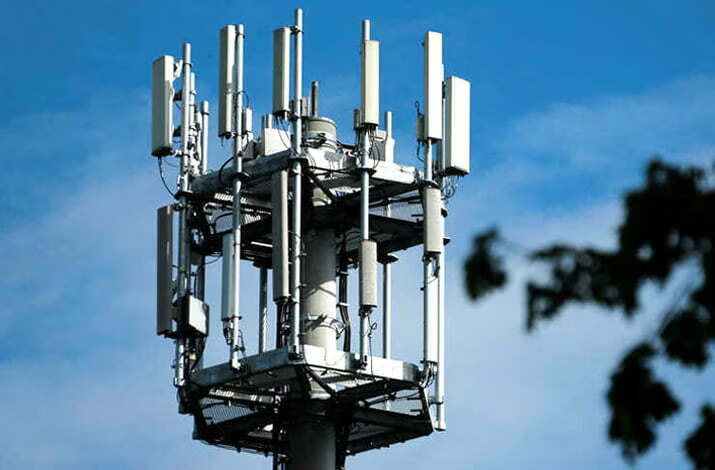
What Is Array Digital Infrastructure?
If you have a cell tower lease with US Cellular — or if you recently received a notice that your lease has been assigned to a new company — you may already be dealing with Array Digital Infrastructure without knowing it.
Array Digital Infrastructure, Inc. (NYSE: AD) is the company formerly known as United States Cellular Corporation (UScellular). On August 1, 2025, UScellular completed the sale of its wireless operations and a significant portion of its wireless spectrum to T-Mobile for approximately $4.3 billion. (See our article on T-Mobile’s acquisition of US Cellular spectrum) What remained after that transaction — the towers — was rebranded as Array Digital Infrastructure and repositioned as a standalone tower company.
In short, if you have a ground lease with US Cellular, your landlord is now Array Digital Infrastructure.
Contact Us
Array Digital Infrastructure Fundamentals
The Tower Portfolio
Array Digital owns approximately 4,450 cell towers located across 19 states, primarily in rural and mid-sized markets where UScellular historically operated. That portfolio makes Array the fifth-largest tower company in the United States by tower count, behind American Tower, Crown Castle, SBA Communications, and Vertical Bridge. One of the distinguishing features of Array’s tower portfolio is its relative isolation from competition — the company reports that roughly one-third of its towers have no competing tower structure within a two-mile radius. That concentration in markets with limited alternatives is both an asset for Array (towers that can’t easily be replaced tend to hold their value) and a meaningful fact for landowners (towers in isolated locations are less likely to be abandoned). On the negative side, Array Digital has failed to adequately market its sites in the past, preferring to “go it alone”. As a result, there are fewer subtenants on the Array Digital towers, and the towers aren’t as valuable as other portfolios of similar age.The T-Mobile Master License Agreement
The centerpiece of Array’s new business model is a 15-year Master License Agreement (MLA) with T-Mobile. Under that agreement:- T-Mobile committed to lease space on a minimum of 2,015 incremental towers for 15 years;
- T-Mobile extended its existing lease term on approximately 600 towers where it was already a tenant to a new 15-year term.
Array Is Not Building New Towers
Unlike most tower companies, Array Digital is not in the business of new tower construction. Their model is focused on leasing space on existing towers in their portfolio to wireless carriers. If you are an Array Digital leaseholder, you will not be approached by them about a new tower build on your property — that is simply not part of their strategy.What Does This Mean for Landowners With Array Digital Leases?
Lease Extensions Are Likely Coming
With T-Mobile locked into approximately 2,600 towers for 15 years, Array Digital has a strong incentive to ensure those ground leases are secured for a comparable term. A 15-year commitment to T-Mobile is worth very little if the underlying ground lease only has three or five years remaining. For those towers, we expect Array Digital to begin contacting landowners about lease extensions — and sooner rather than later.
We haven’t heard of widespread outreach to landowners yet, but we anticipate it is coming as Array gets its footing as an independent company and works through its integration priorities. If and when you receive an extension proposal from Array Digital Infrastructure — or from anyone acting on their behalf — you should treat it exactly as you would a lease extension proposal from American Tower, Crown Castle, or any other tower company. Please contact us before you sign anything.
The 1,800 Interim Tower Sites Are a Wild Card
The approximately 1,800 towers covered only by T-Mobile’s interim licenses are the most uncertain part of Array’s portfolio from a landowner’s perspective. T-Mobile has up to 30 months to decide whether to commit to those sites long-term or to walk away. As T-Mobile finishes integrating the former US Cellular network, it will be evaluating which of those sites it actually needs.
Landowners with towers in this interim category should expect one of two outcomes: either T-Mobile converts to a long-term agreement (which is good for the lease’s value) or T-Mobile exits the site (which may ultimately lead to Array terminating the ground lease if there are no other tenants). We do not yet know which direction T-Mobile will go on most of these sites, and neither does Array. What we do know from prior carrier mergers — AT&T/Cingular, T-Mobile/Sprint, Verizon/Alltel — is that decisions about redundant or marginal sites are eventually made, and not always in the landowner’s favor.
Renegotiation Requests May Be on the Horizon
As Array works through which towers in its portfolio are core long-term assets and which are not, the company has a financial incentive to reduce its ground lease obligations on towers with low or no tenancy. However, if history is any indication, other carriers have used these “mergers” or acquisitions to negotiate down the rent on sites they plan to keep as well. The lease-negotiation agents may “infer” that the site is vacant now that US Cellular has shut down the network. They may know that T-Mobile plans to use the site and “forget” to mention that important fact while trying to get you to agree to concessions. Long story short- don’t blindly accept their suggestion that you have to renegotiate. Even if the site is one that T-Mobile does not intend to keep, it does not mean you have to accept their proposed terms. You can trust us to lead you in the right direction- even if it means giving you free advice.
How Steel in the Air Helps Array Digital Leaseholders
Steel in the Air treats Array Digital Infrastructure the same way we treat any other tower company — as a sophisticated, well-resourced counterparty that has every incentive to minimize what it pays you and maximize what it extracts from your lease. That doesn’t make them bad actors; it just means that you need someone in your corner who knows what these agreements are worth and how these companies negotiate.
The most common situations in which we assist Array Digital leaseholders are:
- Array Digital Lease Extension Proposal: Array (or an agent acting on their behalf) contacts you to extend the term of your existing ground lease, typically offering a nominal signing bonus and sometimes a modest rent increase. Before you accept, contact us — we can tell you whether the proposed terms are fair and how much room there is to negotiate.
- Array Digital Lease Buyout Offer:You may receive an offer from Array or from a third-party company seeking to purchase the ground rights under your existing tower through a perpetual easement or long-term buyout. These offers almost always significantly undervalue the lease. We can evaluate the offer against your actual lease value and the current market.
- Array Digital Expansion or Consent Request: Array may contact you to request consent to modify equipment on the tower, expand the lease footprint, or sublease tower space to additional wireless carriers. In many cases, you are not obligated to consent without compensation, and these requests represent an opportunity to improve your lease terms.
- Array Digital Lease Renegotiation Request: If Array — or a third-party optimization company — contacts you to reduce your rent or otherwise modify your lease terms, do not agree to anything without speaking to us first. We have seen this playbook many times, and it is rarely in the landowner’s interest to accept the first proposal.
Please contact us with any questions about a proposal you have received from Array Digital Infrastructure, or to get ahead of a proposal you are expecting. The initial discussion is free.

Insider tips
- Array Digital entered the tower business under unusual circumstances — it didn’t build a tower company; it became one after shedding its wireless operations. That means the organization is still maturing in its role as a standalone tower company, and its processes for dealing with landowners are likely still evolving. Don’t assume that what you hear from their leasing team today reflects final policy.
- The T-Mobile MLA is the engine that drives Array’s revenue. Towers under the MLA are highly valuable to Array and are very unlikely to be abandoned. If your tower is one of the 2,600 committed MLA sites, your lease has real value — and Array will want to secure it.
- The approximately 1,800 interim sites are a different story. If you are unsure whether your tower falls into the committed MLA category or the interim category, contact us. We can often help you determine this from available data.
- Before any carrier merger or tower transaction is fully settled, renegotiation requests tend to follow. We have assisted landowners through the AT&T/Cingular, T-Mobile/Sprint, and T-Mobile/US Cellular transactions. The pattern is consistent: companies use the uncertainty of a transition to pressure landowners into accepting worse terms. Don’t let the uncertainty work against you.